Status : Launched
Status : Launched
0-to-1 copy trading experience for a crypto exchange in 200+ markets
0-to-1 copy trading experience for a crypto exchange in 200+ markets

OVERVIEW
OVERVIEW
Followers had no one left to follow, and top traders had no reason to stay public. Neither side could be fixed without the other.
Followers had no one left to follow, and top traders had no reason to stay public. Neither side could be fixed without the other.
Nov 2025 – Apr 2026
Product Designer
Nov 2025 – Apr 2026
Product Designer
0-to-1 Product Design // User Research // Stakeholder Interviews // Usability Testing // Cross-functional Alignment
0-to-1 Product Design // User Research // Stakeholder Interviews // Usability Testing // Cross-functional Alignment
Collaborated with
Copy Trading Squad & 3 Non-tech Teams
Collaborated with
Copy Trading Squad
& 3 Non-tech Teams
Collaborated with
Copy Trading Squad & 3 Non-tech Teams
Worked with one Android, iOS, Web, and Backend engineer each, and a PM, alongside Legal, Compliance, and BD teams to ensure regulatory alignment and gather regional market insights.
Worked with one Android, iOS, Web, and Backend engineer each, and a PM, alongside Legal, Compliance, and BD teams to ensure regulatory alignment and gather regional market insights.
IMPACT
IMPACT
86% of copy slots filled at launch, driving 15% incremental volume with zero cannibalization
86% of copy slots filled at launch, driving 15% incremental volume with zero cannibalization
Copy slots filled at first launch
Incremental trading volume
Volume per copier vs. before
Copy slots filled at first launch
Copy slots filled at first launch
Incremental trading volume
Incremental trading volume
Volume per copier vs. before
Volume per copier vs. before
PROCESS
Every assumption was tested three times: before the first design, after it, and again after launch

BACKGROUND
BACKGROUND
Flipster is a crypto perpetuals trading platform serving 200+ countries
Flipster is a crypto perpetuals trading platform serving 200+ countries
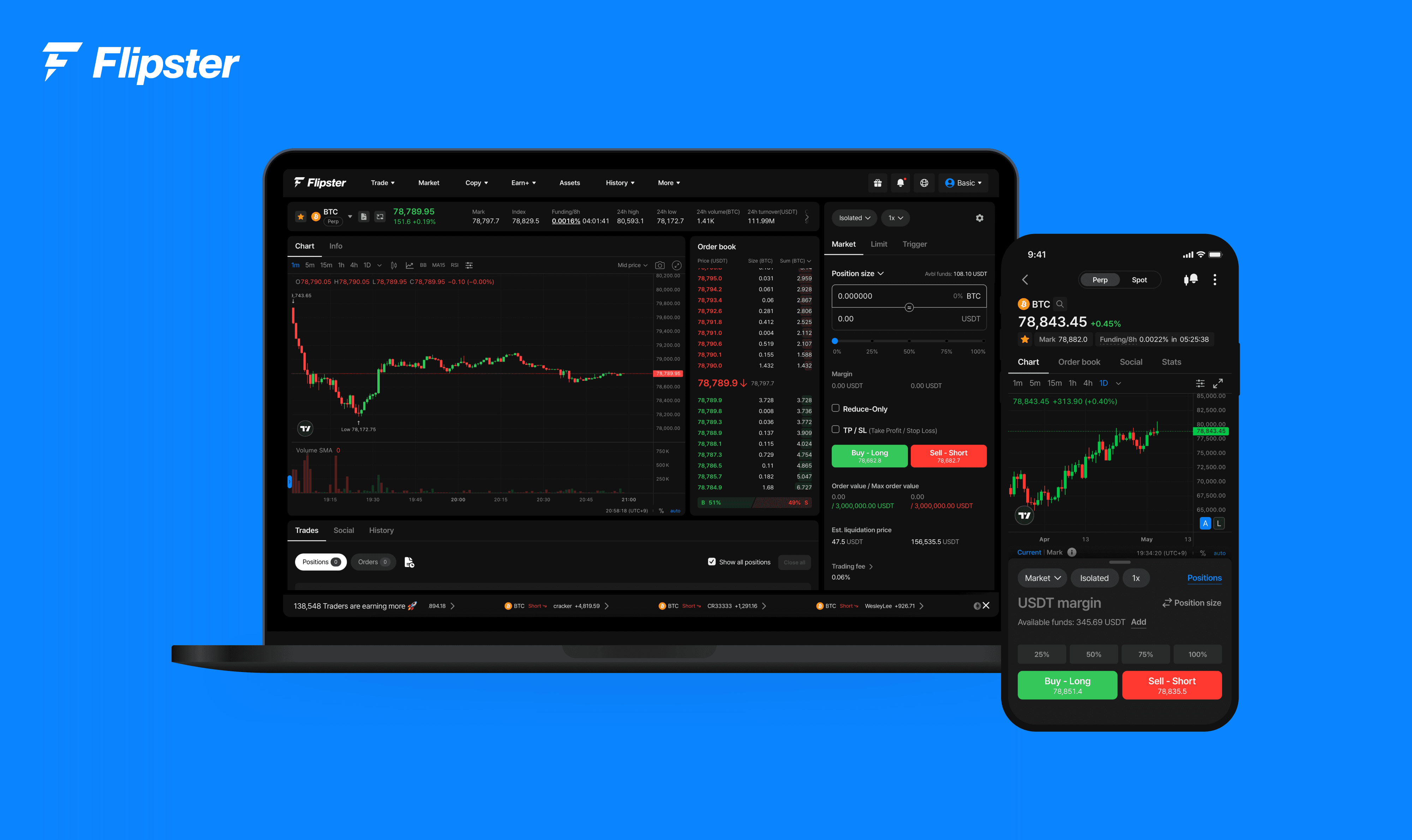
Flipster specializes in perpetual trading with leveraged futures positions, strategically focused on South Korea, China, Taiwan, Russia, UAE, and Vietnam. Unlike professional-focused platforms, Flipster is positioned to make crypto trading accessible to a wider audience. But targeting a broader user base came with its own set of challenges.
Flipster specializes in perpetual trading with leveraged futures positions, strategically focused on South Korea, China, Taiwan, Russia, UAE, and Vietnam. Unlike professional-focused platforms, Flipster is positioned to make crypto trading accessible to a wider audience. But targeting a broader user base came with its own set of challenges.
USER NEEDS
USER NEEDS
84% of users would rather follow someone than trade on their own judgment
84% of users would rather follow someone than trade on their own judgment
I don't trust my own calls, so I check what other traders are doing and follow them in.
I lost badly trading on my own, so losses scare me now. I follow traders who earn in bull runs and lose less when the market turns.
Perpetual trading asks users to pick direction, leverage, and timing all at once. For most, those were never calls they wanted to make alone.
Perpetual trading asks users to pick direction, leverage, and timing all at once. For most, those were never calls they wanted to make alone.
PROBLEM
PROBLEM
The more users turned on position alerts, the fewer traders stayed public
The more users turned on position alerts, the fewer traders stayed public
Business Problem
Top traders had nothing to gain from staying public
Top traders had nothing to gain from staying public
Traders ranked in the top 10 repeatedly began setting their history to private, since exposure grew with no reward to offset it. Follow usage halved over the same period.
Traders ranked in the top 10 repeatedly began setting their history to private, since exposure grew with no reward to offset it. Follow usage halved over the same period.
User Problem
Followers were losing the traders they came for
Followers were losing the traders they came for
84% of users preferred a follow-the-leader strategy over trading on their own judgment, yet 30% were already going to other exchanges to do it.
84% of users preferred a follow-the-leader strategy over trading on their own judgment, yet 30% were already going to other exchanges to do it.
OPPORTUNITY
OPPORTUNITY
Copy trading gave both sides a reason
Copy trading gave both sides a reason
For Master Traders
For Master Traders
Exposure finally pays
Exposure finally pays
Master traders now earn a share of what their copiers make, set between 10~30%. The exposure that used to be a pure cost became the thing that pays.
Master traders now earn a share of what their copiers make, set between 10~30%. The exposure that used to be a pure cost became the thing that pays.
For Copiers
For Copiers
Nothing to catch, nothing to time
Nothing to catch, nothing to time
Every position the master trader opens is mirrored automatically, at the size the copier chose. No charts, no 24/7 monitoring.
Every position the master trader opens is mirrored automatically, at the size the copier chose. No charts, no 24/7 monitoring.
HYPOTHESIS
If a master trader's positions are mirrored into a copier's account automatically, more users will place their first trade, and that will bring in volume the exchange wasn't capturing before.
PROCESS
Every assumption was tested three times: before the first design, after it, and again after launch
CONSTRAINTS
Binance's approach couldn't work here
Couldn't build every advanced setting with limited resources
Turn simplicity into the strategy, essentials only.
Couldn't win on brand recognition
Give copy trading its own tab,
front and center
Couldn't offer hundreds of traders to choose from
Spotlight each one, making fewer choices feel like a feature.
USABILITY TEST
Global user research to challenge our assumptions and uncover blind spots
Before jumping into development, I ran usability tests with 6 users across South Korea, Taiwan, China, and Vietnam. The goal was to validate the core flow: discovering a trader, learning more about them, and deciding to start copying.
HYPOTHESIS
If a master trader's positions are mirrored automatically, more users will place their first trade and bring in volume the exchange wasn't capturing.
CONSTRAINTS & DESIGN DECISIONS
Binance's approach couldn't work here
Constraints
Design Decisions
Couldn't offer hundreds of traders
to choose from
Couldn't offer hundreds of traders to choose from
Spotlight each one,
making fewer choices feel like a feature.
Spotlight each one, making fewer choices feel like a feature.
Couldn't build every advanced setting
with limited resources
Couldn't build every advanced setting with limited resources
Turn simplicity into the strategy, essentials only.
Couldn't win on brand recognition
Couldn't win on brand recognition
Give copy trading its own tab,
front and center.
Give copy trading its own tab, front and center
USABILITY TEST
Global user research to challenge our assumptions and uncover blind spots
Before jumping into development, I ran usability tests with 6 users across South Korea, Taiwan, China, and Vietnam. The goal was to validate the core flow: discovering a trader, learning more about them, and deciding to start copying.


IMPROVEMENT 1 ) DISCOVERY
Make traders comparable at a glance
IA Exploration

Before
After


Testing showed the top of the screen was working against itself. A permanent Copy activity panel sat above the traders, so the first thing someone saw was their own balance rather than who they might copy.
I tried shrinking the hero, cutting it entirely, and moving activity to its own tab. The tab won because it was the only option that didn't make activity compete for the same space. I then cut each trader card down to what's needed to shortlist someone: ROI trend, win rate, turnover, leverage. Everything else moved into the profile, and three traders now fit where one used to.
IMPROVEMENT 2) PROFILE EXPLORATION
Answer the questions in the order they're asked
Before
After


I had packed the key metrics above the fold, assuming that seeing everything at once would make the call faster. Testing showed the opposite: with nothing ranked, people didn't know where to start. What they wanted first was ROI and the P&L trend, so I moved those to the top and ordered the rest the way people asked for it, grouping the supporting metrics under labels instead of listing them flat.
IMPROVEMENT 3) START COPYING
Split the setup where the thinking changes
Setting Flow Exploration

Before
After
Putting the whole setup on one screen made it look like a form to fill in rather than a decision to make. The trade-off was real though: every extra step is a place to drop off, so I only split where the questions were genuinely different in kind.
Entering an amount and reviewing settings are different kinds of thinking, so those became separate steps. Position mode came out as its own step later, once it was clear people were skimming past a choice that changes their returns. Each step carries the trader's own defaults, so there's always an answer already in the field.
Prototype
Prototyped with Claude Code
Concluding Thoughts
Copy trading isn't a new idea. What I had to decide was which parts of it to show first, on a platform without the trader pool or the brand recognition to compete feature for feature. I shipped four settings, and every cut had to survive the same question: does someone need this to place their first copy, or only their tenth? The same logic shaped the copy, since most of our users read English as a second language. I turned titles into questions, so the structure was predictable before the sentence was read.
What I'd still want is localisation that goes past translation. Korea, Taiwan and Vietnam behave differently enough that the same screen probably shouldn't lead with the same number. Shipping one version was the right call for an MVP, but it's the first thing I'd revisit.
Thanks for Watching!
Final Output
Prototyped with Claude Code
Concluding Thoughts
The most challenging part was figuring out what it should look like without a playbook to follow. Other exchanges have years of iteration behind theirs. We were starting from zero, with different constraints and a different audience. Usability testing early became the way to move with confidence instead of assumption.
Global user research shifted the entire direction. Copy trading exists on most major exchanges, but most users have never actually used it. That insight pushed the approach toward reducing friction over adding features — and shaped almost every decision that followed.
Thanks for Watching!
Concluding Thoughts
A key learning from this project was adapting our research methodology to overcome cultural barriers in Korea, where even people in their mid to late 20s tend to be relatively conservative about dating and stigmatize dating app users as those who should be filtered out. Through pilot interviews, I discovered how this stigma led participants to downplay their app usage and provide socially desirable responses. For the main study, I addressed this by conducting research under the guise of academic study - yielding more authentic feedback. However, the real breakthrough came through usability tests, where the 'think aloud' protocol finally enabled us to capture unfiltered user perspectives.
The academic foundation from my concurrent master's studies greatly helped establish these research protocols and build organizational buy-in for user-centered approaches, ultimately becoming the catalyst for establishing the organization's first sustainable foundation for UX research. Particularly, implementing 'VoC Read Aloud Sessions' to share raw user feedback with team members transformed initial skepticism into empathy and naturally led to problem-solving ideas.
Thanks for Watching!
Final Output
Profile pictures were enlarged for better visibility of critical user information. The redesign prioritized system recommendations and reduced uncertainty, ensuring intuitive navigation through clear hierarchy from day one.
Visual previews of potential voice chat interactions were added to reduce user anxiety. The preview content was sped up for intuitive comprehension.
DISCOVERY
Remove distractions so users could focus on discovering traders
Before
After
Testing showed the top of the screen was working against itself. A permanent Copy activity panel sat above the traders, so the first thing someone saw was their own balance rather than who they might copy.
I tried shrinking the hero, cutting it entirely, and moving activity to its own tab. The tab won because it was the only option that didn't make activity compete for the same space. I then cut each trader card down to what's needed to shortlist someone: ROI trend, win rate, turnover, leverage. Everything else moved into the profile, and three traders now fit where one used to.
PROFILE EXPLORATION
Answer the questions in the order they're asked
Before
After
I had packed the key metrics above the fold, assuming that seeing everything at once would make the call faster. Testing showed the opposite: with nothing ranked, people didn't know where to start. What they wanted first was ROI and the P&L trend, so I moved those to the top and ordered the rest the way people asked for it, grouping the supporting metrics under labels instead of listing them flat.
Copier earnings mattered more than I expected. People weren't only judging the trader, they were checking whether copying them had actually paid for anyone else, so I gave earnings its own tab instead of a line inside the profile.
START COPYING
Split the setup where the thinking changes
Before
After
Putting the whole setup on one screen made it look like a form to fill in rather than a decision to make. The trade-off was real though: every extra step is a place to drop off, so I only split where the questions were genuinely different in kind.
Entering an amount and reviewing settings are different kinds of thinking, so those became separate steps. Position mode came out as its own step later, once it was clear people were skimming past a choice that changes their returns. Each step carries the trader's own defaults, so there's always an answer already in the field.
© 2026 Juyeon Park. All rights reserved.
Built with Cursor, Claude and caffeine